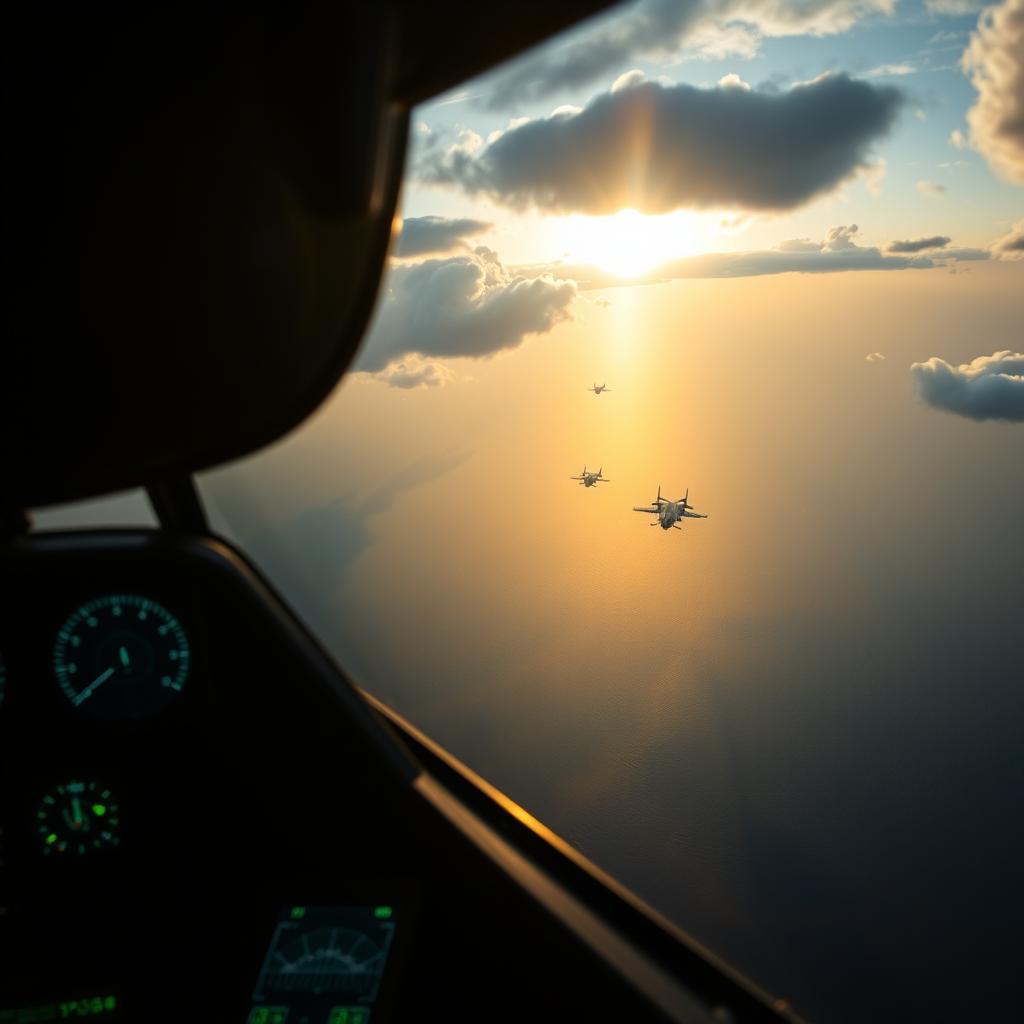
A U.S. Navy pilot assigned to IHSM-73 filed a formal UAP range fouler debrief form documenting three unidentified small air contacts observed during routine operations in the North Arabian Sea at approximately 00:04:30 Zulu on August 24, 2020. The contacts generated no radar trackfile, no IFF response, and no electronic warfare indications, according to Department of War document DOW-UAP-D56.
What the Pilot Observed
According to the debrief form, the reporting pilot — an O-3 flying as pilot in command — initially acquired a single unknown air contact and maintained visual tracking before losing sight of it as it passed behind a cloud cover. Upon reacquisition, the pilot identified a total of three contacts in the same group. The contacts appeared to be on a westerly heading, recorded in the form as approximately 270 degrees, though speed was listed as unknown.
The form describes the contacts as round in shape, with apparent wings or airframe structure visible, and as reflective. No markings, moving parts, apparent propulsion, or translucency were noted. Distance to the contacts was also listed as unknown, leaving altitude differential and closing geometry unresolved. The contacts were observed at night, with the aircraft operating at approximately 22,000 feet. No interaction between the pilot's aircraft and the unknown contacts took place.
The pilot's own narrative, preserved in the form's open-comment field, reads in part:
"I observed 3x possible unidentified small air contact while conducting routine operations in the North Arabian Sea. Negative ES, radar track, and IFF track. Distance to contact was unknown. Speed of contact was unknown. Precise course of contact was unknown, but appeared to be on a westerly heading. No interaction took place... Initially observed 1x unknown air contact and tracked it before losing sight as it went behind a cloud."
The aircraft involved was Bureau Number 168122, a side-number 705 platform, flying a mission described in the form fields consistent with a large force exercise environment. The LFE field is marked affirmative, suggesting the contact occurred during a multi-unit training evolution rather than a single-aircraft patrol.
Reporting System and Data Limitations
The form was submitted through SPEAR — the Navy's Safety and Performance Evaluation and Airspace Risk reporting infrastructure — which sanitizes all identifying information for aircrew and squadron before the data is used in analysis. The system instructs pilots to derive latitude and longitude for contacts using JMPS sensor-bearing and range data referenced against a bullseye, or any reasonable derivation if JMPS is unavailable. In this case, the contact's precise location is recorded only as operating in Working Area W-72, with the contact latitude and longitude fields not fully legible in the available document.
No stable radar trackfile was established, and the self-track and TFLIR autotrack checkboxes were left unchecked, indicating the contacts were observed visually without sensor lock. The absence of electronic support measures data — listed as "Negative ES" — means no radar emissions or electronic signatures were detected from the contacts, which forecloses some conventional explanations such as drone platforms equipped with active sensors or transponders.
Three contacts moving in loose formation on a consistent westerly heading, exhibiting a reflective and structured appearance but producing no electronic signature and no radar return, remain unexplained based on the information recorded in the debrief.
Context and Reliability Caveats
The document is sourced from war.gov and carries a source trust rating of 60 percent, reflecting uncertainty about full document provenance and the partially degraded state of the scanned form, which contains OCR artifacts and illegible sections. Key data fields including precise contact coordinates and portions of the pilot narrative are only partially recoverable from the available text. The document's format and field structure are consistent with known SPEAR UAP debrief forms that have appeared in prior congressional and defense reporting contexts.
The Arabian Sea incident predates the formal stood-up reporting infrastructure that followed the June 2021 ODNI preliminary assessment, placing it in a period when UAP reporting was being actively encouraged but before standardized collection was fully institutionalized across the fleet. The report's existence, regardless of what the contacts ultimately were, reflects the kind of first-person aircrew documentation that analysts and congressional overseers have said is essential to any rigorous assessment of the phenomenon.